
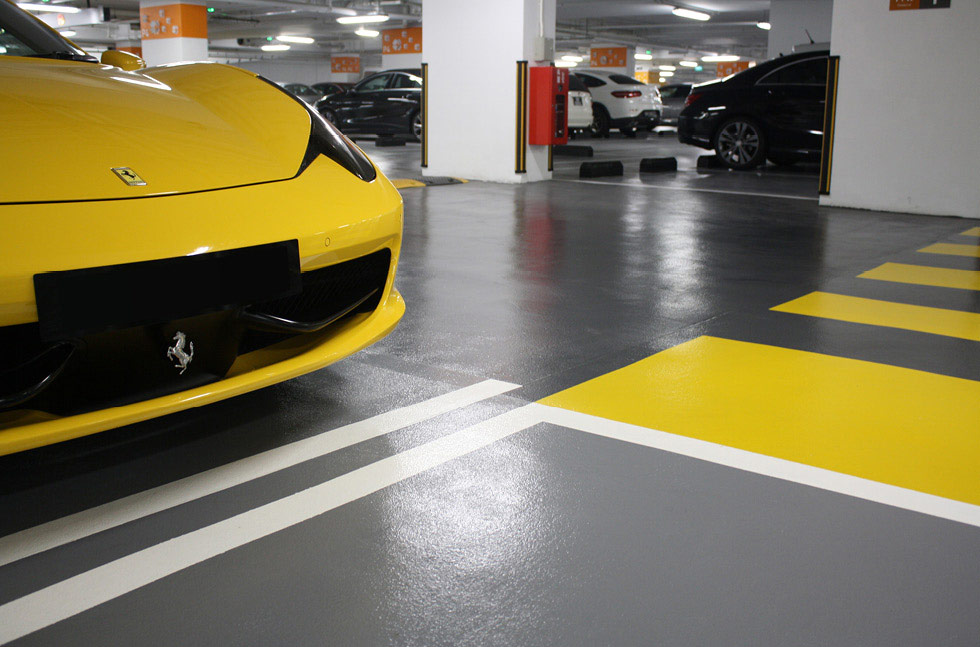
Car park floor coating
A car park floor is the first thing your customer touches, every single day.
Residents and tenants may never see your terrace. They drive across the parking deck twice a day, and they judge the building by how it looks, sounds and holds up.
What clients tell us first
The concerns behind the enquiry.
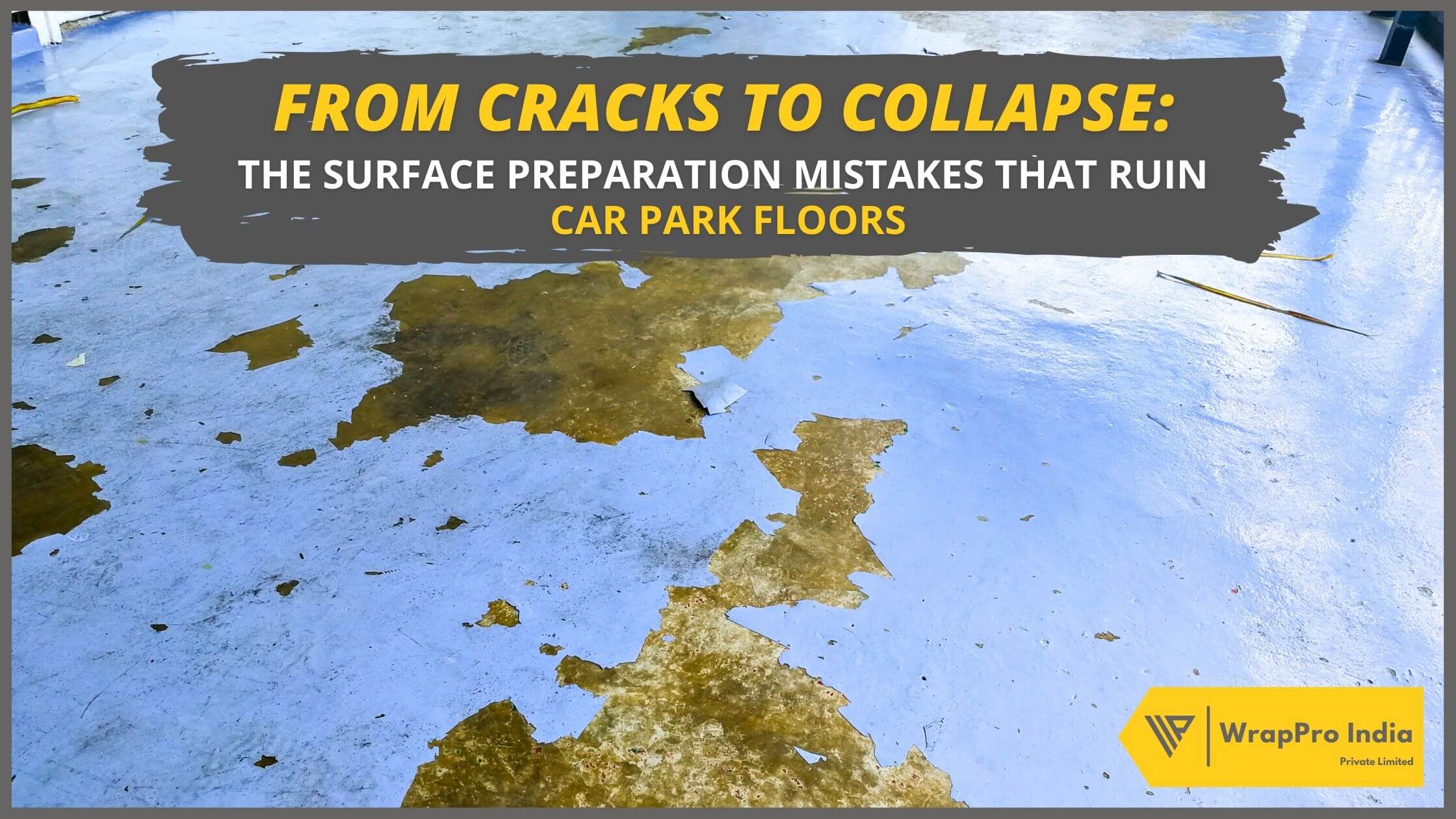
“The last coating peeled within two years.”
Almost always a preparation or moisture issue, not a product issue. Coatings do not fail in the tin — they fail against a slab that was too smooth, too damp or too contaminated to bond to. We test before we quote so you are not paying twice.
“Which is right for us, PU or epoxy?”
It is decided by the deck, not by preference. Enclosed basement levels suit epoxy's hardness and cost; exposed podiums and top decks need PU's flexibility and UV stability. If someone offers one answer for every level, that is a commercial answer.
“We cannot shut the parking down.”
Then the programme is part of the specification. We plan the work in zones, agree access and cure windows with your facility team, and tell you honestly how long each bay is out of use.
Where it really goes wrong
What actually causes the failure.
01
Preparation skipped
Mechanical preparation, laitance removal and moisture testing are what create the bond. They are also the first things removed to reach a lower rate.
02
Wrong system for the exposure
Epoxy on an exposed top deck chalks and embrittles under UV; a soft system in a heavy-turning ramp scuffs and tears. The failure is in the choice.
03
Ramps treated like flat floors
Ramps and turning circles take braking, torque and water. Without anti-skid broadcast and reinforced build-up, they wear out years before the rest of the deck.
04
Cracks and joints coated over
A coating cannot bridge a moving joint. Coated over, that joint reappears as a line of failure within a season.
How we approach it
What we do differently, and why it matters to you.
We survey before we specify
Substrate soundness, moisture content, existing coatings, traffic pattern and exposure decide the system and the build-up — level by level, not building-wide.
Preparation quoted as scope, not as goodwill
Grinding or shot blasting, crack treatment and joint detailing appear explicitly in our scope, so you can see exactly what a cheaper quotation has removed.
Ramps and turning areas engineered separately
Anti-skid aggregate, thicker build-ups and reinforced detailing where the vehicle actually works the floor.
Finished as a usable space
Line marking, bay numbering, wayfinding and edge detailing so the deck reads as a well-run building, not as a coated slab.
Scope & systems
What this scope covers.
A trafficked floor is an engineered wearing surface. PU or epoxy is not a preference — it is decided by exposure, traffic and load.
Systems we use
- PU deck coatings for exposed and podium parking
- Epoxy systems for enclosed basement parking
- Anti-skid aggregate broadcast for ramps
- Line marking, bay numbering and wayfinding
Typically specified for
- Basement and podium car parks
- Ramps and turning circles
- Parking above habitable space
- Renewal of existing coated floors
What you get
What actually reaches you at the end of it.
- A level-by-level system recommendation with the reasoning shown
- Moisture and substrate test results before application
- Preparation and crack treatment written into the scope
- Zoned programme agreed with your facility or project team
- Line marking and wayfinding delivered as part of the finish
- A floor your residents and tenants notice for the right reasons
Questions
What clients ask us about this scope.
The choice should be based on the way the car park is used.
Epoxy systems are widely used where hardness, abrasion resistance and a clean finish are priorities. Polyurethane systems can offer greater flexibility and can be better suited where movement, impact or more demanding service conditions are expected.
In many projects, the most effective specification is not about choosing one material for the entire car park, but selecting the appropriate build-up for each zone.
Not always.
Ramps, turning areas and driveways experience much higher tyre friction, braking forces and abrasion than parking bays.
These zones may require a heavier-duty build-up, greater texture or additional aggregate to withstand the higher mechanical stress.
A zoned specification can improve durability without unnecessarily over-specifying lower-stress areas.
Delamination is often linked to poor bonding with the concrete rather than to the visible topcoat itself.
Typical causes include inadequate surface preparation, weak concrete, dust or oil contamination, trapped moisture, unsuitable existing coatings or application over a substrate that has not been properly assessed.
A durable coating therefore begins with the condition of the floor beneath it.
The texture should match the area of use.
Ramps and vehicular zones generally need greater slip resistance, while parking bays and pedestrian areas can often use a smoother finish.
Too little texture can compromise safety; too much can make cleaning difficult and increase dirt retention.
The objective is to balance safety, durability and maintainability.
Downtime depends on the system, area condition and curing requirements.
In occupied buildings, the work can often be planned in phases so that sections of the car park remain operational while other zones are being prepared and coated.
Good phasing and traffic management are often as important as the coating itself when working in residential, commercial or institutional properties.
Sometimes.
If the existing coating is well bonded and the substrate is sound, rehabilitation may be possible with local repairs, mechanical preparation and a compatible new coating system.
Where there is widespread delamination, contamination or substrate weakness, more extensive removal may be necessary.
The existing floor should therefore be assessed before deciding whether to repair, overlay or replace.
Look beyond the final price.
Compare the proposed system thickness, surface preparation, treatment of cracks and joints, coating build-up, aggregate content, traffic-zone design, slip resistance, material consumption, application methodology and warranty conditions.
Two systems described simply as “PU flooring” or “epoxy flooring” may differ substantially in actual performance.
Cracks and joints should not simply be coated over without understanding their behaviour.
Static cracks, moving cracks and structural or construction joints may require different treatments. If movement is expected, the detailing needs to accommodate it rather than relying on the floor coating alone.
Ignoring these areas can lead to reflective cracking and premature failure of the finished surface.
Related
Other scopes on the same building
Insights
Related Articles
Next step
Tell us what is worrying you about this scope.
Send us the drawings or the specification you have been handed. We will tell you where we agree, where we would do it differently, and exactly what a lower quotation has left out.